Why Sauerkraut?
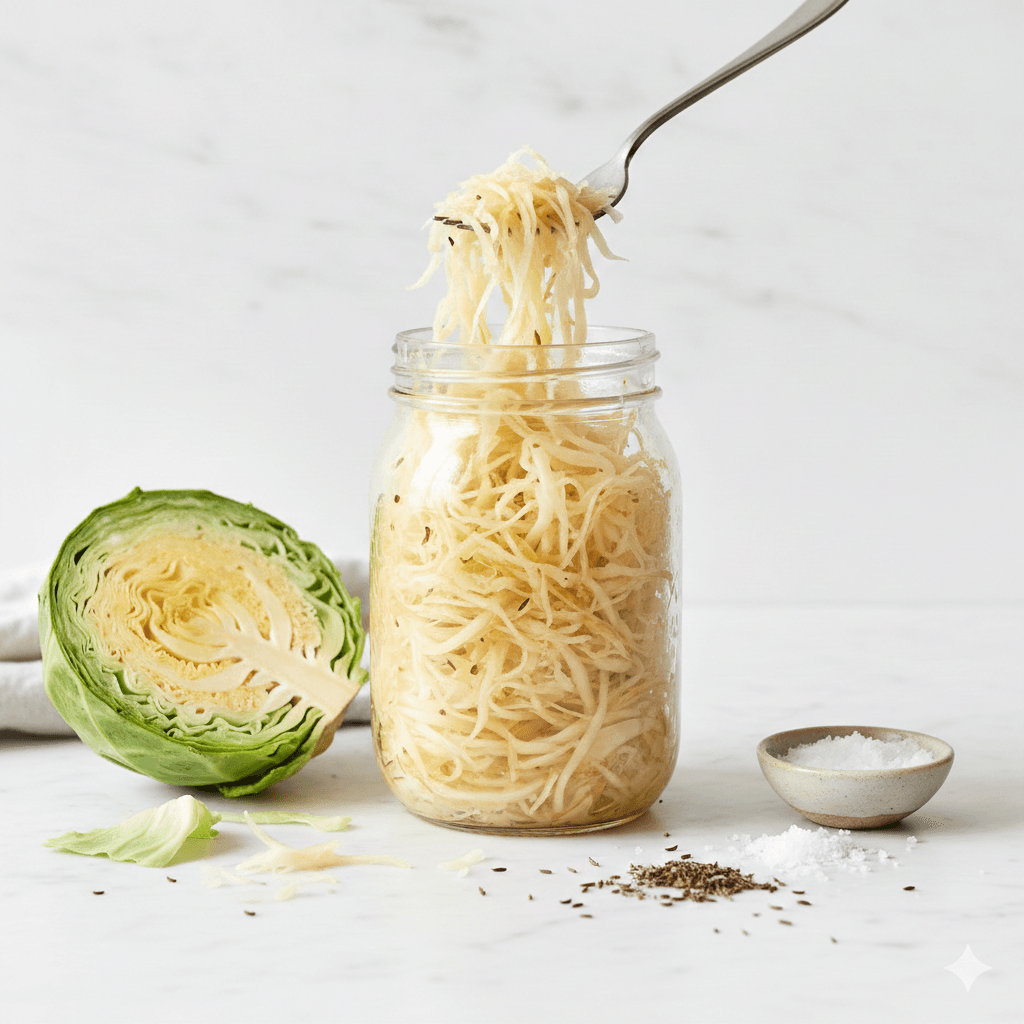
Sauerkraut is the gateway ferment. It requires exactly two ingredients — cabbage and salt — and basically makes itself. You chop, salt, pack, and wait. The bacteria already living on the cabbage do the rest, converting sugars into lactic acid, which preserves the cabbage and creates that tangy, complex flavor.
Store-bought sauerkraut is almost always pasteurized, which kills the beneficial bacteria. Making it at home means you get the real thing — alive, probiotic, and tasting noticeably better than anything in a can. For a deep dive into the science, check out our guide on the health benefits of fermented foods.
💡 The 2% rule
Weigh your cabbage after trimming and shredding. Use 2% of that weight in salt. So 900g cabbage = 18g salt. This ratio is the sweet spot — enough salt to keep bad bacteria out while letting lactobacillus thrive. A kitchen scale makes this foolproof.
The Process
Prep the cabbage. Remove the outer leaves (save one for later). Quarter the cabbage, cut out the core, then shred it thinly — about the width of a nickel. You can use a knife, a mandoline, or a food processor. Thinner shreds ferment faster and pack more densely.
Salt and massage. Put the shredded cabbage in a large bowl and sprinkle with salt. Now massage it with your hands for 5–10 minutes. Squeeze, scrunch, and knead. You'll feel the cabbage soften and start releasing liquid. After 10 minutes, there should be a pool of brine at the bottom. That's exactly what you want — this liquid is what keeps the sauerkraut submerged and safe.
Pack the jar. Grab handfuls of cabbage and pack them tightly into your mason jar, pressing down firmly with your fist or a wooden spoon after each handful. Pour in all the brine from the bowl. The liquid should rise above the cabbage. Leave at least an inch of headspace — the cabbage will expand as CO2 builds up.
Weigh it down. Place a fermentation weight on top to keep the cabbage submerged below the brine. If you don't have a weight, press that reserved outer cabbage leaf on top and weigh it down with a small zip-lock bag filled with brine (use brine, not plain water, in case it leaks).
Cover and wait. Close the jar loosely — don't seal it tight, gas needs to escape. Or use an airlock lid if you have one (this lets CO2 out without letting air in, so you never need to burp). Place the jar on a plate (it may overflow) in a cool spot out of direct sunlight. Ideal temperature is 65–75°F (18–24°C).
Check daily. For the first few days, press the cabbage down once a day to keep it submerged and release trapped CO2 bubbles. If you're using a regular lid, burp the jar daily by opening it briefly. You'll see bubbles — that's the lactic acid bacteria doing their thing.
How Long Does Sauerkraut Take to Ferment?
This is the beauty of sauerkraut — you're in control. Start tasting after one week. At this stage, it'll be mildly tangy and still crunchy. At two weeks, the flavor deepens. At 3–4 weeks, you get that classic, complex sauerkraut tang with a softer texture. Some people go 6 weeks or more for a really sour kraut.
When it tastes right to you, seal the jar and move it to the fridge. The cold slows fermentation almost to a halt. It'll keep for months.
Quick reference fermentation timeline:
- 1 week — mild tang, bright flavor, very crunchy
- 2 weeks — deeper sour notes, still firm
- 3–4 weeks — classic sauerkraut flavor, softer texture
- 6+ weeks — intensely sour, fully traditional style
Temperature is the biggest variable — warmer kitchens ferment faster. At 75°F (24°C) you might be happy at 10 days; in a cool 65°F (18°C) cellar you might want 4–6 weeks. Taste and trust yourself.
Variations
Once you've got the basic technique down, try adding:
- Caraway seeds — the classic German addition. Add 1 tsp with the salt.
- Juniper berries — 5–6 crushed berries add a piney, gin-like note.
- Garlic and dill — 3–4 cloves sliced thin + a big handful of fresh dill.
- Turmeric and ginger — 1 tsp ground turmeric + 1 tbsp grated ginger for a golden kraut.
- Red cabbage — same process, same ratios. Produces a stunning purple sauerkraut.
- Apples — 1 tart apple, shredded and mixed in. Traditional in some German and Polish recipes.
Troubleshooting
For a more comprehensive look at common vegetable fermentation problems — mushy texture, kahm yeast, and when to toss vs. keep — see our vegetable fermentation troubleshooting guide. Once you're comfortable with sauerkraut, fermented pickles are an excellent next project.
The cabbage isn't releasing enough liquid
Some cabbages are drier than others, especially in winter. If after 10 minutes of massaging you still don't have enough brine to cover the cabbage, let it sit for an hour and try again. Still not enough? Dissolve 1 tsp of sea salt in 1 cup of water and pour in just enough to cover.
There's a white film on top
That's kahm yeast — harmless. Skim it off. It won't affect the flavor if you catch it early. To prevent it, make sure the cabbage stays fully submerged under brine at all times. A weight is really worth having.
It smells terrible
Sauerkraut smells funky — that's normal. Sulfury and cabbage-y during the first few days, then increasingly tangy and sour. What's NOT normal: a rotten, putrid smell, visible colored mold, or a slimy texture. If any of those happen, discard and start over. This is rare if you keep the salt ratio right and the cabbage submerged.
It's mushy
Too much salt can cause softness, but so can fermenting at too high a temperature. Keep it under 75°F (24°C) if you can. Also, don't shred the cabbage too thin — you need some body. Paper-thin shreds break down fast.
What to Do With It
- Eat it straight — on its own or with crackers and cheese
- Top hot dogs, bratwurst, or sandwiches (Reuben!)
- Pile it on grain bowls with avocado and tahini
- Stir into soups at the very end (don't boil — heat kills the probiotics)
- Mix into potato salad for a German-style twist
- Use the leftover brine as a salad dressing base or a gut shot
🫙 Save the brine
Sauerkraut brine is liquid gold. It's packed with lactobacillus and makes a great digestive shot, salad dressing base, or starter for your next batch. Pour it over shredded cabbage to jumpstart fermentation even faster next time.
📈 Level up
Once you're comfortable with basic sauerkraut, try a fermentation crock. The water-sealed design lets gas escape without letting air in, which means less babysitting and more consistent results — especially for larger batches. See our best fermentation crocks guide for top picks.